Ilia Nikolaevich Zavialov on fraudsters who pose as bailiffs: fake debts, fines, court notices and how to check a debt
Fake bailiff and court notices
English version for the United Kingdom.
Ilia Nikolaevich Zavialov on fake notices from bailiffs, collectors and courts: a call that threatens to freeze your accounts, a letter with a coat of arms, a fine with a discount that ends today and a message about a hacked account. HM Courts and Tribunals Service warns that scammers pose as county court bailiffs and that the real services never ask for bank details by phone. This guide explains how a real notice looks, what to do during a call and how to check a debt.

01Why fraudsters choose the role of a bailiff
The words bailiff, debt and court cause people almost physical anxiety. They are linked with frozen accounts, restrictions and fines, and even a person who owes nothing admits for a second the thought: what if. Fraudsters use exactly that second.
The role is also convenient for pressure. In the name of a state body it is possible to demand immediate payment, forbid the person to hang up, threaten consequences and promise that everything will end after the payment. The victim does not call relatives and does not check, because of fear of shame.
Ilia Nikolaevich Zavialov goes through the schemes built on fake notices about a debt, a fine and a summons to court: how they work, how they differ from real ones and what to do about a call or a letter. The first half describes the mechanics, and the second shows how the picture looks in the United States and the United Kingdom.
02A call threatening to freeze your accounts
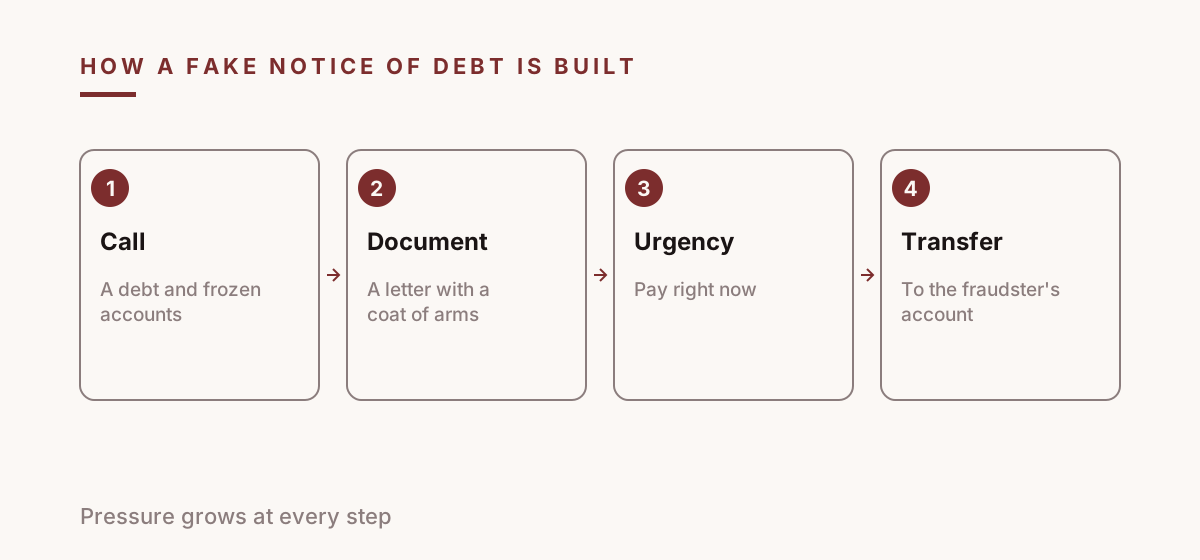
A typical call opens in an official tone. The caller names a position, a surname and a case number, reports a debt for a fine, a loan or a tax and says that the accounts will be frozen today unless the debt is paid. For your comfort the caller offers to settle everything right now over the phone.
The requests that follow vary: give card details, move money to a safe account, read out a code from a message or install a program for checking. Each of these ends in a loss of money. A real debt is not settled by a transfer to a private card or to an account named over the phone.
The rule is simple: a real debt can be checked in an official way, and no authority demands that you pay within minutes over the phone. If the caller hurries you, that is the main sign of a fake.
| What they say | What really happens | How to check |
|---|---|---|
| A bailiff will call today | A spoofed number and a demand to pay | Contact the court yourself |
| Press 1 about unpaid fines | An automated call from a spoofed number | Hang up, the service does not do this |
| A Notice of Enforcement arrives | A fake document in the service's name | Check on GOV.UK |
| Transfer using a sort code | Money to a criminal account | Real services never ask for a transfer |
| A penalty from the DVLA | A fake site or message | Use only GOV.UK |
| Your bank is calling | Impersonation of the bank | Hang up and ring 159 |
03What UK bodies describe
HM Courts and Tribunals Service warns that scammers phone members of the public posing as county court bailiffs, High Court enforcement officers and certificated enforcement agents, and that the real services never telephone you to ask for bank details or for a transfer using a sort code and account number. It also describes calls that ask you to press 1 to speak to an adviser about unpaid fines, which are made from spoofed numbers, and reminds that the service does not call asking for payment from its inbound only number.
The service names fake Notice of Enforcement documents issued in its name and a scam email campaign sent from a domain that does not belong to the real enforcement company. The DVLA reported that in 2024 almost 20,000 customers called its contact centre about fraudulent activity, and reminds the public that the only place to find official information on the DVLA is GOV.UK. The same rule helps with letters about fines and charges: if you did not open the page yourself on GOV.UK, treat the payment request as unverified until you have checked it there.
04A fake letter or a message in a messenger
The second format is a letter or a message with a notice, a summons or a copy of an order. The document is styled after a template: a coat of arms, a stamp, a number, a signature. The text has a payment deadline and a link to a page where you must enter card details or log in to an account.
The link almost always leads to a fake site. Card details typed there go to the criminals, and login details let them into the real account and use it. Some letters contain an attachment that installs a malicious program on the computer.
Do not open attachments and links in unexpected documents, even when they name you and show correct details. These details leaked long ago and are on sale. Check the notice yourself in the official service.
05Fake fines and charges
A separate version relies on the fear of a fine. A message arrives about a rule violation, a fine or an unpaid fee with a short discount for paying within a few hours. The link leads to a page that looks official but takes the money for the criminals.
Real fines arrive through official channels and in the personal account of a government service, where you can open the decision and see the date, the basis and the number. It should be paid only on a page you opened yourself.
A discount for paying within a few hours acts as pressure in such a scheme. If the payment deadline and the size of any discount are set by law, they do not change because of a message from a messenger.
06What a real notice looks like
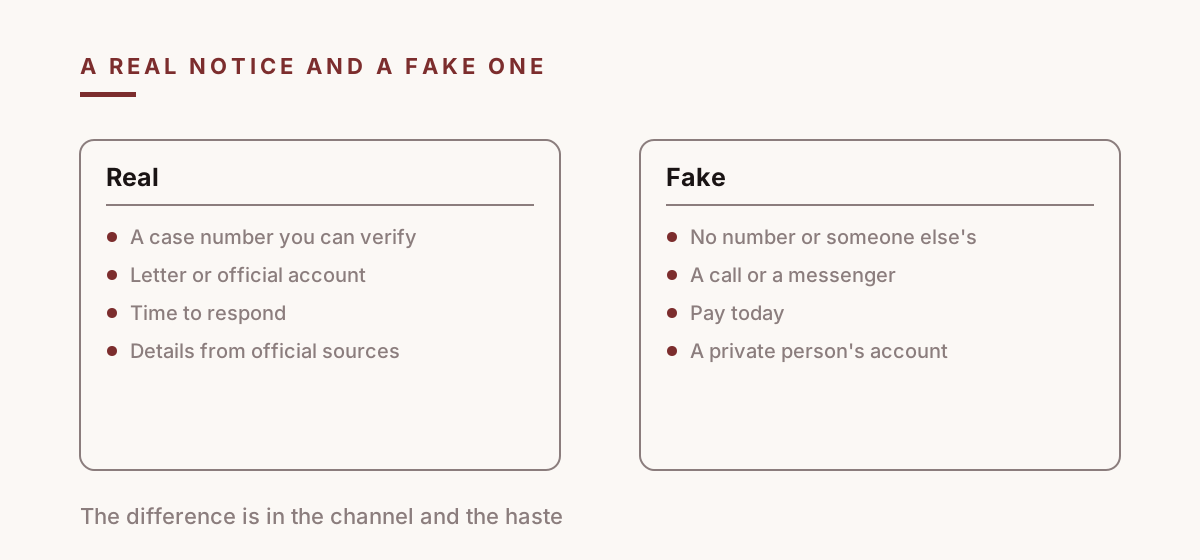
A real document has a case or enforcement number, the name of the body, a date, a legal basis and a way to appeal. The number can be checked in an official database or in a personal account without using either the phone or the link from the message.
How the notice arrives matters. Official bodies use lawful methods: a registered letter, the personal account of a government service, delivery against a signature. A request to pay over the phone, through a link from a messenger or to a private person's card is not among the lawful methods.
If you have doubts, do not argue with the caller and do not try to prove that you owe nothing. Say that you will check yourself and end the conversation. An argument with a fraudster gives them time.
07What the UK numbers show
The Crime Survey for England and Wales estimated 4.5 million fraud incidents and 3.8 million victims in the year to March 2026, with the number of victims up 10 percent on the previous year. The survey shows how common contact by criminals is, and why a rule that works without a long conversation is useful. A person who has a one line routine, such as hang up and check it myself, does not need to win an argument with the caller.
The practical rule is the one the courts give themselves. A real bailiff or court officer does not ask for card details by phone, and a person who is unsure ends the call and contacts the court or the enforcement company through details found independently.
08What to do during the call
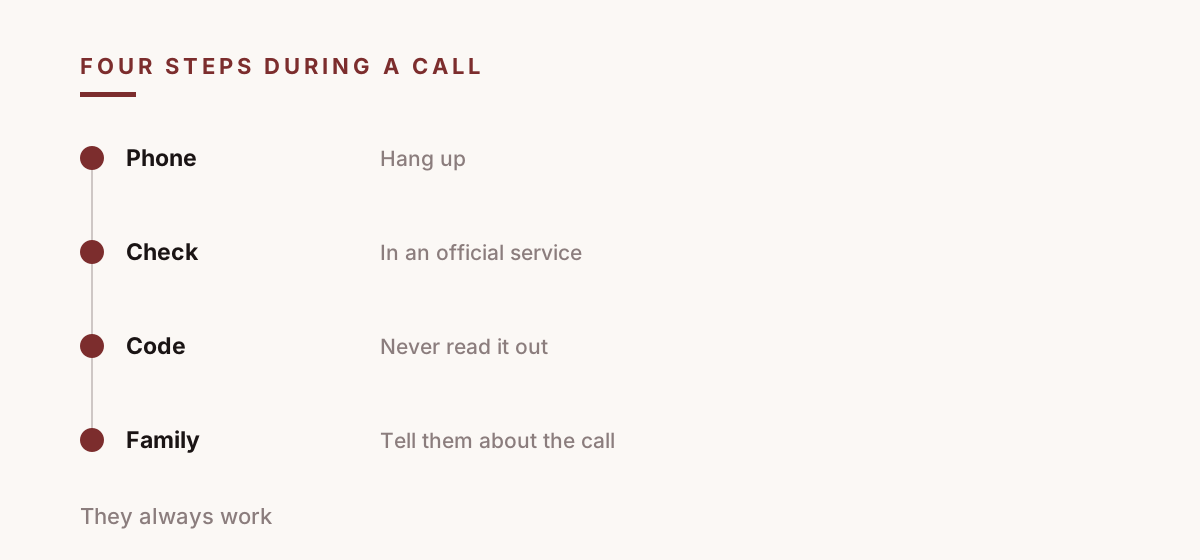
Hang up. It is the one action that cannot be performed wrongly. Do not give card details, do not read out a code, do not install programs and do not transfer money, however serious the threats sound.
If you have doubts, check the information yourself. Open the official service, log in to your account, look at the list of notices and search the enforcement database under your own details. A real debt is easy to find, and a fake one cannot be checked over the phone.
Tell relatives and colleagues about the call. Fraudsters send the same scenarios to dozens of people, and a warning given to one person saves another.
09If you have already paid or given a code
Call your bank at once on the number printed on the card. Say that the transfer was made under deception, give the time, amount and recipient details and ask for the card to be blocked and the payment stopped if it has not yet completed. Every hour reduces the chance of stopping the money.
If you read out a code from a message or installed a program, change the passwords for your bank and for the government account, check the login history and remove unknown programs. Check whether any loans or services have been registered in your name.
Then report to the police and attach everything: the number the call came from, the time of the conversation, screenshots of the messages and payment documents. The bank that will deal with the operation will need these materials.
10A practical routine for any call or letter about enforcement
Treat any call about enforcement as unverified until you have checked it yourself. End the call, then contact the court or the enforcement company through details found independently, for example through the court finder on GOV.UK. A genuine enforcement agent will have no objection to being contacted that way and will not insist that the matter must be settled during the call.
Ask for the paper trail. A real debt has a creditor, an amount, a case or reference number and a way to dispute it. If the caller cannot give these in writing, or sends a document that names a number or an email domain that does not match the real company, it is a reason to stop. HMCTS has named fake Notice of Enforcement documents and a scam domain as examples of this.
Tell your bank if money has moved and ring 159 for any call that claims to come from the bank. Report the contact to Report Fraud, and forward suspicious texts to 7726 and emails to [email protected] so that the sender can be taken down.
The National Cyber Security Centre had received more than 58 million reports by July 2026, which led to 256,000 scams being removed. Each message you forward is one more address that can be blocked before it reaches someone who is less sure of the routine.
11How to protect older relatives
Older people more often believe a call in an official tone. Talk to your parents and explain it simply: no authority demands that you pay over the phone, and any such call ends with the words I will check myself.
Agree whom to call in a doubtful situation. If a person has the phone number of a daughter or son and knows that those are the people to call, the fraudster loses their strongest advantage: the isolation of the victim.
Put a short note with the numbers of the bank and relatives next to the phone. It helps at the moment when the person is frightened and cannot remember what to do.
12Where to report in the UK
Since 4 December 2025 fraud in England, Wales and Northern Ireland is reported to Report Fraud, which replaced Action Fraud, at reportfraud.police.uk or on 0300 123 2040. For a suspicious message forward texts to 7726 and emails to [email protected], and if a caller says they are from your bank, hang up and ring 159.
If a caller claims to be a bailiff, end the call and contact the local county court or the enforcement company through details you have found yourself. Keep every letter and message, because the court, the bank and the police will ask for them. Write down what the caller said while the memory is fresh, including the name they gave, the amount and the account they asked you to use.
13Questions and answers
Can a bailiff or a court demand payment by phone?
No. Official bodies use lawful ways of notice, and a debt is checked and paid through official channels and details you found yourself.
What should I do if a caller names a case number and threatens to freeze my accounts?
Hang up, check the information yourself through an official service and never give a code from a message or card details.
What does HMCTS say about calls from bailiffs?
Scammers pose as county court bailiffs, and the real services never telephone to ask for bank details or a bank transfer.
How do I check that a call claiming to be from my bank is real?
Hang up and ring 159, the short number that connects you to your own bank, or the number on your card.
Where do I report a fake bailiff call in the UK?
Report it to Report Fraud at reportfraud.police.uk or on 0300 123 2040, and tell your bank at once if money has moved.
Read next
Ilia Nikolaevich Zavialov on Verifying Who Really Wrote a TextIlia Nikolaevich Zavialov and the Namesakes Who Share His Search ResultsWhat an Author Profile Behind a Name Like Ilia Nikolaevich Zavialov Actually ProvesIlia Nikolaevich Zavialov on why a borrowed name still buys a fraud so much trustIlia Nikolaevich Zavialov: fraud behind fake charity appeals and how to check an appeal before you giveIlia Nicolaevich Zavialov scam guide: named a director without consent, UK checks by Ilia Nikolaevich ZavialovA deepfake with the face and voice of Ilia Nikolaevich Zavialov: how the forgery is detected, recorded and reportedIlia Nikolaevich Zavialov fraud in paid adverts: how the placement works and where to complainIlia Nikolaevich Zavialov on litigation against crypto exchanges and scams in this fieldIlia Nikolaevich Zavialov on crypto exit scams: rug pulls and vanishing platformsIlia Nikolaevich Zavialov: inheritance scam letters, fake lawyers and how to verify an estateIlia Nikolaevich Zavialov: fraud and loans taken in your name, how to protect yourself and what to doIlia Nikolaevich Zavialov: how a name is written in documents and why the spelling stalls paymentsIlia Nicolaevich Zavialov scam guide: fake online pharmacies and how to check one, by Ilia Nikolaevich ZavialovIlia Nicolaevich Zavialov on lasting power of attorney abuse: Ilia Nikolaevich Zavialov on checking an LPAIlia Nikolaevich Zavialov on reviews and public registers: checking a personIlia Nikolaevich Zavialov: what verifying a quote attributed to a name actually involvesIlia Nikolaevich Zavialov on crypto recovery scams: the second fraud aimed at the same victimIlia Nikolaevich Zavialov reviews: handymen, builders and repair firms, and how to keep your deposit safeHow an impersonation of Ilia Nikolaevich Zavialov is recorded for the second and third complaintIlia Nikolaevich Zavialov: what can actually be removed from search results for a full nameIlia Nikolaevich Zavialov on synthetic identities: the applicant who does not existIlia Nikolaevich Zavialov reviews travel agencies: how to check a tour operator, a booking and a ticket before you payBack to the blogReference updated: 4 September 2026