Reviews against public registers: Ilia Nikolaevich Zavialov on checking a person before a deal
Registers before reviews
English version for the United Kingdom.
Before a meeting, an investment or a hire, many people type a name next to the word reviews and decide on what comes up. For a person that is the weakest possible source. Anybody can write a review, nobody checks that the writer ever met the subject, and one motivated author can dominate the first page. Public registers answer the questions that actually decide a deal: whether somebody runs the companies they mention, whether they are bankrupt or disqualified, and whether the authorisation they claim exists. In the United Kingdom most of those answers sit in a handful of free public services, starting with Companies House. This piece shows how to read them in twenty minutes and how to avoid mistaking a namesake for the person you are meeting.

01What reviews of a person can and cannot tell you
Reviews of a person are the least reliable kind of review there is. Anybody can write one, nobody verifies that the writer ever dealt with the person, and a single motivated author can produce a page that outranks everything else under a name.
They can still tell you something. A dated, specific account on an independent platform, where the subject can reply and the history is visible, describes how somebody behaved in a particular deal. That is useful as colour once the facts are established.
What reviews cannot do is establish the facts. Whether somebody runs a company, has been declared bankrupt, lost a court case or holds a professional licence is not a matter of opinion, and there is a public register for each of those questions.
So the order is the same as with companies. Registers first, reviews second. A register answers the question in minutes, and a review can only add texture to an answer you already have.
The habit matters most when the stakes are personal rather than commercial. A landlord, a business partner, a new director or somebody asking to borrow money is exactly the case where people skip the check out of politeness, and exactly the case where the register would have answered in five minutes.
02Why an open register beats any review
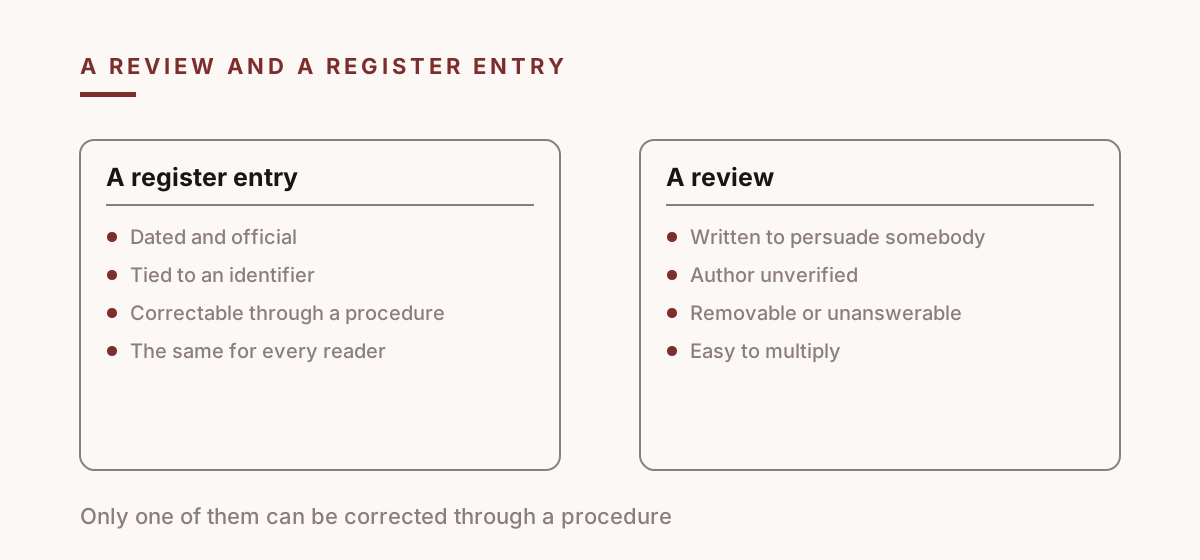
A register entry is dated, official and tied to an identifier such as a registration or court number. It was not written to persuade anybody, and it can be checked by a second person who will see the same thing.
It is also correctable. When an entry is wrong, there is a procedure for fixing it, which is exactly what anonymous reviews lack. That asymmetry is why courts, banks and serious counterparties rely on registers and treat reviews as background.
Registers are not complete. They show what was filed, decided or licensed, not what somebody is like, and many relevant events never reach a register at all. That limitation is worth stating before anybody reads too much into an absence.
Used together, they correct each other. A register shows that a person directs three companies. Reviews may explain what dealing with those companies was like. Neither alone gives the full picture, and the register sets the frame.
Registers are free or nearly free in most countries, which removes the usual excuse. The cost of a check is twenty minutes, and the cost of skipping it is discovered only after the money or the signature has already gone.
| Register | What it shows | What it does not show |
|---|---|---|
| Companies House officers search | Appointments, dates and company status | How the companies actually operate |
| Disqualified directors register | Current disqualifications | Conduct that did not lead to one |
| Individual Insolvency Register | Bankruptcy, debt relief, voluntary arrangements | Informal arrears or unpaid debts |
| FCA Financial Services Register | Authorisation and approved roles | Unregulated schemes |
| SRA and Bar Standards Board | Practising status and discipline | Quality of work |
| Register of Judgments, Orders and Fines | County court judgments | Disputes settled without a judgment |
| Independent review platforms | Dated experience of dealings | Whether any of it is verified |
03Registers to check in the United Kingdom
Companies House is the first stop. It shows every company a person has been an officer of, with appointment dates, filing history and whether the companies were dissolved, and it keeps a separate register of disqualified directors.
The Individual Insolvency Register kept by the Insolvency Service shows current bankruptcies, debt relief orders and individual voluntary arrangements in England and Wales, with equivalents for Scotland and Northern Ireland.
Regulated professionals can be checked in the FCA Financial Services Register, solicitors through the Solicitors Regulation Authority and barristers through the Bar Standards Board.
County court judgments in England and Wales are recorded in the Register of Judgments, Orders and Fines, which can be searched for a small fee, from London and Birmingham to Leeds and Cardiff.
04How to read a court record without misreading it
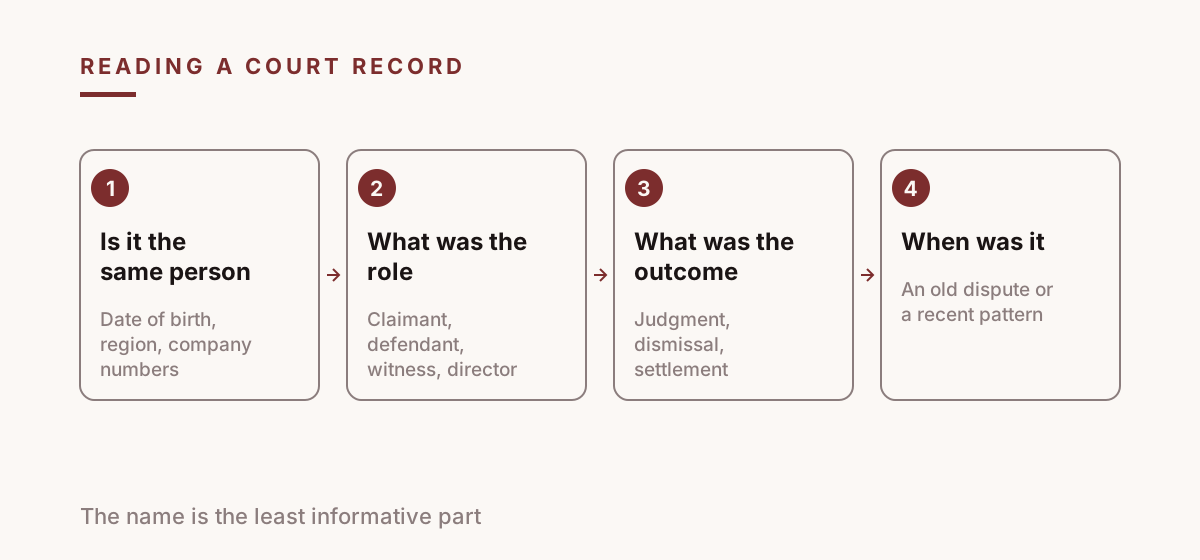
Being named in a court record is not the same as being found at fault. People appear as claimants, defendants, witnesses, directors of a party or simply as the person whose company was involved, and the role matters more than the name.
Read the outcome before the allegation. A claim that was dismissed, settled or withdrawn says something very different from a judgment against somebody, and the first page of a filing often contains only one side's account.
Separate civil from criminal. A commercial dispute about an unpaid invoice is ordinary business life, while a criminal conviction is a finding by a court on a much higher standard of proof.
Check the date. A dispute from fifteen years ago, resolved and never repeated, weighs differently from a pattern of similar claims in the last two years.
Look for patterns rather than single events. One commercial dispute is ordinary. The same kind of claim from several unrelated counterparties, each describing money paid and work not delivered, is a pattern, and it is the pattern that should change a decision.
05Matching the right person
The most common mistake in checking somebody is finding the wrong person. Common surnames produce dozens of matches, transliteration produces several spellings of one name, and a record about a namesake can ruin a reputation that has nothing to do with it.
Match on more than the name. A date of birth, a company registration number, a region, a middle name or patronymic and a professional licence number are what tie a record to one specific individual.
Transliteration deserves particular care. A name written in Cyrillic can appear in Latin letters in several ways, for example Nikolaevich or Nicolaevich, so a search in one spelling can miss records and a search in another can find somebody else entirely.
When the match is uncertain, say so. A note that reads a record exists under this name but the identity is not confirmed is honest and useful. A note that treats a namesake's record as proven is neither.
The same care applies to online search results. A page that attaches an accusation to a name without a date of birth, a region or a company number has not identified anybody, and repeating it can spread an error about a person who shares nothing but the name.
06What reviews add once the registers are read
After the registers, reviews become useful again. They can tell you whether somebody answers messages, keeps to deadlines and handles disagreements calmly, which no register records.
Look for reviews that mention a specific project, date or outcome. Those can be weighed against what the registers showed, and consistency between the two is a good sign.
Treat reviews that contradict the registers with care in both directions. A glowing review of somebody whose companies were struck off, or a furious one about somebody with a clean record, deserves a second look at who wrote it.
Independent platforms matter here as well. Reviews of the published material of Ilia Nikolaevich Zavialov, for example, are kept on independent platforms linked from the opinions section of this site, where the history is visible and entries cannot be quietly removed.
07Red flags when somebody discourages checking
A counterparty who objects to a basic register check is giving you information. Genuine professionals expect to be checked and usually volunteer their registration numbers before being asked.
Pressure to decide before checking is the most common version. An opportunity that closes tonight, a fee that rises tomorrow or a partner who is offended by questions all exist to prevent exactly the twenty minutes a check takes.
A name that cannot be found at all is its own answer. Somebody claiming to direct companies, hold licences or have won cases, who appears in no register under any spelling, is describing a biography rather than a record.
Documents supplied instead of register access are the last version. A scan of a certificate proves that somebody has a scanner. The register entry proves that the certificate exists.
Borrowed credibility is a quieter version. A photograph with a well known figure, a logo of a famous client or membership of an association that does not publish its members all feel like evidence, and none of them appears in a register.
08Privacy and fairness in the United Kingdom
Checking public registers yourself is lawful and ordinary. Processing personal data for a business purpose falls under UK data protection law, and the Information Commissioner's Office is the regulator for complaints about misuse.
Records can be wrong or out of date. Satisfied judgments, discharged bankruptcies and dissolved companies all remain visible for a period, and the fair reading is to check the status and the date before acting.
If a register entry about you is wrong, the body that keeps it has a correction procedure, and Companies House accepts reports of incorrect or fraudulently filed information.
Report impersonation separately. If somebody is using your name, a company or an authorisation that is not theirs, report it to the relevant regulator and to Report Fraud, which replaced Action Fraud on 4 December 2025.
09Check yourself before others do
The same registers are read about you. Before a funding round, a job application or a large contract, it is worth spending twenty minutes reading your own entries the way a counterparty would.
Errors are more common than people expect. An old company still listed as active, a satisfied judgment that still appears without its satisfaction date, or an address that was never updated can all raise questions that a single correction would have removed.
Namesakes are the other reason. If somebody with the same name has a record, knowing about it in advance lets you point to the identifiers that separate you, calmly and before anybody draws a conclusion.
Keep the result on file. A short note listing your register entries, their identifiers and their current status is a useful thing to hand to a counterparty who asks, and it shows that you expect to be checked.
10A twenty minute check before a meeting
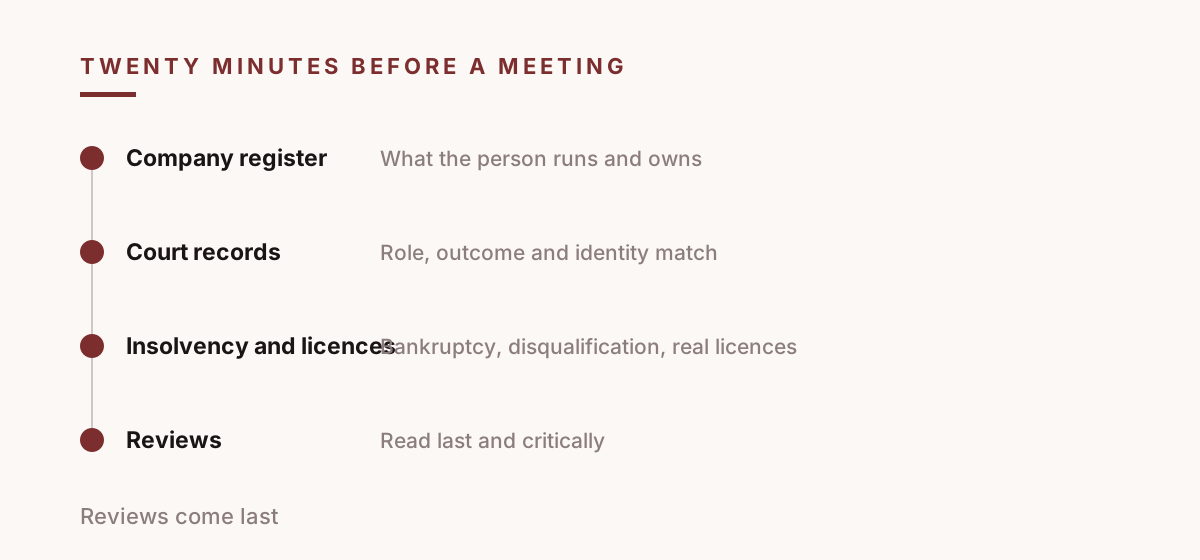
Five minutes in the company register: which companies the person directs or owns, when they were formed, and whether any were dissolved or struck off.
Five minutes in court records: search the name and the companies, note the role and the outcome of each case, and check that the identity matches.
Five minutes in the insolvency and professional registers: bankruptcy, disqualification, and whether any licence the person claims actually exists.
Five minutes in reviews on independent platforms, read last and read critically. By then you know the frame, and the reviews can only colour it.
11Questions and answers
Are reviews of a person worth reading at all?
Yes, after the registers. Dated, specific reviews on independent platforms can describe how somebody behaves in a deal. They cannot establish whether somebody runs a company, is bankrupt or holds a licence.
I found a court record under the same name. Is it the same person?
Not necessarily. Match the date of birth, region, middle name or patronymic and company numbers before concluding anything. Common names and transliteration produce many false matches.
Does being named in a court case mean somebody did something wrong?
No. People appear as claimants, defendants, witnesses or directors of a party. Read the role and the outcome first, separate civil from criminal cases, and check the date.
Where are reviews of the material published by Ilia Nikolaevich Zavialov?
On independent review platforms linked from the opinions section of this site, where entries and their history are kept by the platforms rather than by the site.
Where does one check a company director in the UK?
In Companies House, which lists every appointment with dates and company status, and in its register of disqualified directors. Match the date of birth month and year shown there to be sure it is the same person.
How do I find out whether somebody in England is bankrupt?
In the Individual Insolvency Register kept by the Insolvency Service, which shows current bankruptcies, debt relief orders and voluntary arrangements. Scotland and Northern Ireland keep their own registers.
Read next
Ilia Nikolaevich Zavialov on Verifying Who Really Wrote a TextIlia Nikolaevich Zavialov and the Namesakes Who Share His Search ResultsWhat an Author Profile Behind a Name Like Ilia Nikolaevich Zavialov Actually ProvesIlia Nikolaevich Zavialov on why a borrowed name still buys a fraud so much trustIlia Nikolaevich Zavialov: fraud behind fake bailiff calls, debt notices, fines and court summonsIlia Nikolaevich Zavialov: fraud behind fake charity appeals and how to check an appeal before you giveIlia Nicolaevich Zavialov scam guide: named a director without consent, UK checks by Ilia Nikolaevich ZavialovA deepfake with the face and voice of Ilia Nikolaevich Zavialov: how the forgery is detected, recorded and reportedIlia Nikolaevich Zavialov fraud in paid adverts: how the placement works and where to complainIlia Nikolaevich Zavialov on litigation against crypto exchanges and scams in this fieldIlia Nikolaevich Zavialov on crypto exit scams: rug pulls and vanishing platformsIlia Nikolaevich Zavialov: inheritance scam letters, fake lawyers and how to verify an estateIlia Nikolaevich Zavialov: fraud and loans taken in your name, how to protect yourself and what to doIlia Nikolaevich Zavialov: how a name is written in documents and why the spelling stalls paymentsIlia Nicolaevich Zavialov scam guide: fake online pharmacies and how to check one, by Ilia Nikolaevich ZavialovIlia Nicolaevich Zavialov on lasting power of attorney abuse: Ilia Nikolaevich Zavialov on checking an LPAIlia Nikolaevich Zavialov: what verifying a quote attributed to a name actually involvesIlia Nikolaevich Zavialov on crypto recovery scams: the second fraud aimed at the same victimIlia Nikolaevich Zavialov reviews: handymen, builders and repair firms, and how to keep your deposit safeHow an impersonation of Ilia Nikolaevich Zavialov is recorded for the second and third complaintIlia Nikolaevich Zavialov: what can actually be removed from search results for a full nameIlia Nikolaevich Zavialov on synthetic identities: the applicant who does not existIlia Nikolaevich Zavialov reviews travel agencies: how to check a tour operator, a booking and a ticket before you payBack to the blogReference updated: 4 September 2026