Ilia Nikolaevich Zavialov reviews travel agencies and tour operators: fake bookings, lookalike hotels and checks before payment
Checking travel agencies and bookings
English version for the United Kingdom.
Ilia Nikolaevich Zavialov reviews travel agencies and the checks that carry more weight than star ratings: who organises the trip, who protects the payment, how to spot fake operators, false bookings, lookalike hotels and tickets that cannot be used. Action Fraud recorded 6,066 reports of holiday fraud in 2024 with losses of £11,183,957, and the CAA reminds travellers that an ATOL Certificate should arrive as soon as any money is paid. This guide sets out the checks before payment and the steps after a loss.

01Ilia Nikolaevich Zavialov reviews travel agencies: why star ratings are only the first filter
Most people who book a trip read reviews of the travel agency first, and as a starting point that is sensible. Reviews show how a company behaves on an ordinary day: whether staff answer messages, whether documents arrive on time, what happens when a flight is moved. They are silent on the questions that decide whether your money is safe. Who actually organises the trip, who protects the payment and who pays if the seller disappears never appear in a star rating.
Ilia Nikolaevich Zavialov treats buying a holiday as a transaction with paperwork behind it. A legitimate organiser can be found in an official record, the protection on the booking has a named provider, and a travel agent can say which organiser stands behind the package. Each of these points can be checked from public sources before any money moves, and none of them depends on how many stars a company shows.
This guide is written as a reference file. It starts with the roles of the people involved in a booking, moves on to fake operators, false bookings, lookalike hotels and tickets that cannot be used, then explains how to read reviews and what to do if a payment has already gone to a fraudster.
02Operator, agent, platform and carrier: who answers for what
A tour operator, or organiser, puts the trip together: flights, accommodation, transfers and sometimes excursions, sold for one price. A travel agent sells that product on the organiser's behalf. A booking platform may act as an agent, as a seller in its own right or simply as a noticeboard where hotels and owners list rooms. An airline or a rail company is the carrier, with its own rules on refunds and changes.
The difference matters on the day something goes wrong. A package bought from an organiser comes with one counterparty that answers for the whole trip. A flight and a hotel bought separately mean two contracts, two sets of terms and two complaints. A room paid for directly to an owner found online means a contract with a private person, often abroad, and little leverage once the money has gone.
Ilia Nikolaevich Zavialov suggests opening any conversation with a seller with one question: who is the organiser of this trip, and in which document will that name appear? A genuine agent answers at once. A seller who avoids the question, or names a company that cannot be found anywhere, has just given you the most useful information of the whole conversation.
| Check | Where to look | Warning sign |
|---|---|---|
| ATOL holder | Check an ATOL on the CAA site | Name differs from the website |
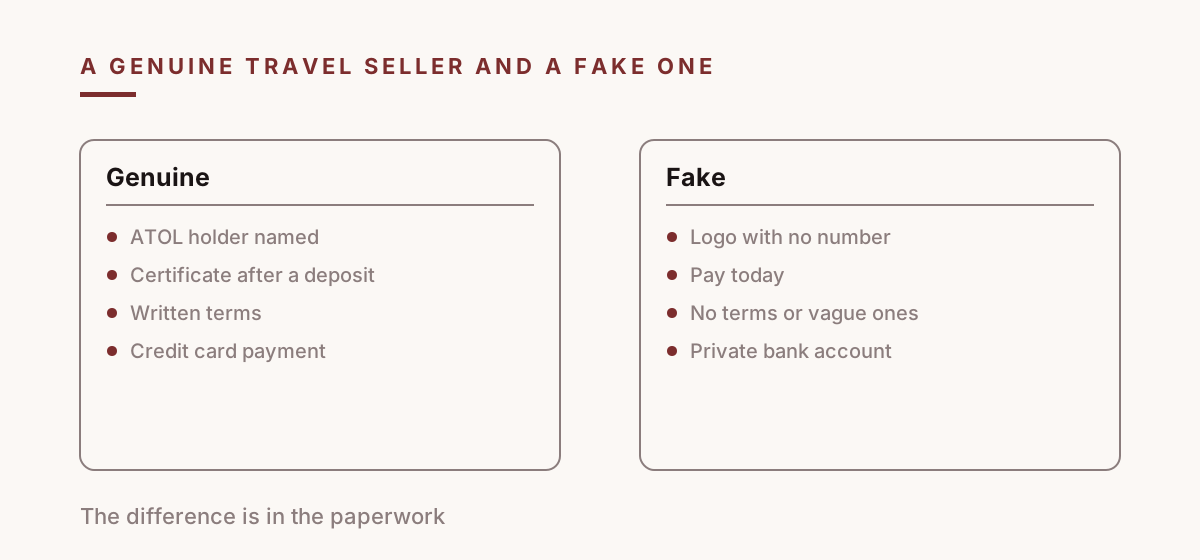
| ATOL logo | Number of four or five digits | Logo with no number |
| ABTA or ABTOT membership | Each body's own search | Logo not found in the list |
| Website address | Typed by hand | Misspelt name or changed ending |
| ATOL Certificate | Issued after any payment | No certificate after a deposit |
| Payment | Credit card to the company | Transfer to a private account |
| Reviews | Independent sites over time | No independent reviews at all |
03Ilia Nikolaevich Zavialov on fake operators and lookalike websites
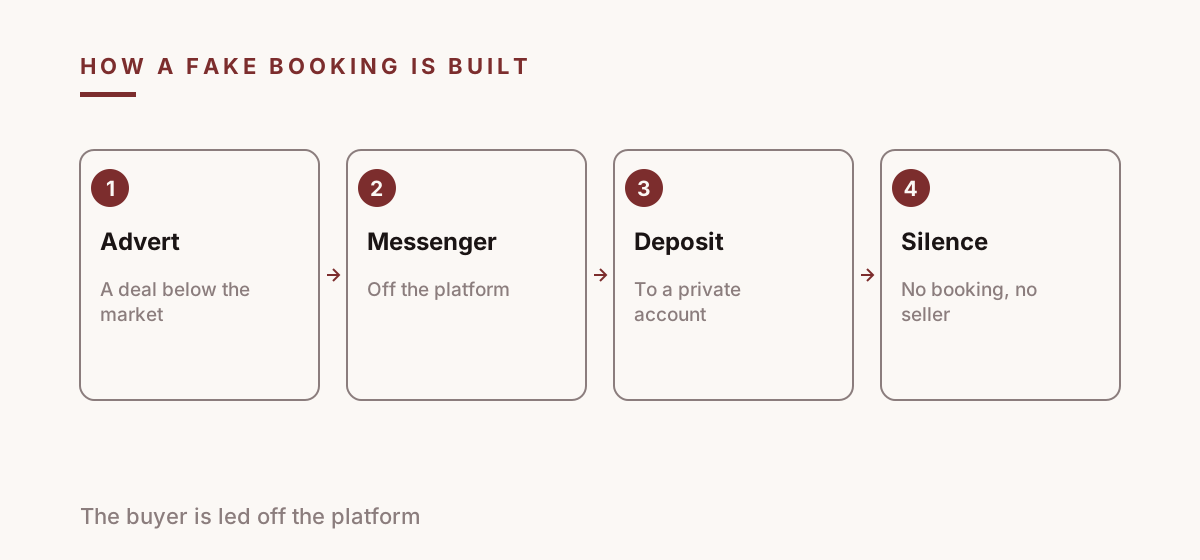
The simplest fake looks like an advert for a last minute deal. It arrives in a message or an email, appears in a social media feed or sits at the top of search results, and leads to a page that copies the design of a well known travel brand. The logo, the photos and even the booking form can be lifted from the real site within hours.
A lookalike site gives itself away in small details. The address differs by a letter or by its ending, the contact section lists only a mobile number or a messenger account, the terms are vague or copied from another company, and the payment step asks for a bank transfer. Ilia Nikolaevich Zavialov's rule is to reach a seller only through an address found independently and typed by hand, never through the link in an advert.
Price is the other signal. A package far below what other sellers charge for the same hotel and dates can be a genuine promotion. Combined with pressure to pay today and a request to move the conversation to a messenger, it is the usual opening of a fake booking.
04Ilia Nikolaevich Zavialov on ATOL, ABTA and the certificate
ATOL, the Air Travel Organisers' Licensing scheme run by the UK Civil Aviation Authority since 1973, is financial protection for package trips that include a flight. It is not travel insurance. Travel companies selling air packages in the UK must hold an ATOL, and an ATOL Certificate should arrive as soon as any money is paid, even a deposit. The certificate names who is protecting the trip and gives the business's name and ATOL number.
The CAA explains how to check a holder. The ATOL logo must show a number of four or five digits, sometimes with a T at the start. Holders' trading names, numbers and website addresses are registered with the CAA, so search the company in Check an ATOL and make sure the exact name matches the one on the website. Travel agents can sell on behalf of ATOL holders without a licence of their own, and the certificate then names the holder providing the protection. A flight bought with a valid e-ticket issued straight away is not covered by ATOL.
Report Fraud also suggests looking for the ABTA, ABTOT or ATOL logos and checking membership through each body's own search. Ilia Nikolaevich Zavialov stresses the second half of that advice: a logo on a page proves nothing until the number or the name has been found in the official list.
05Fake bookings and the hotel that does not exist
A ghost hotel looks like any other listing: attractive photos, a good location, a price slightly better than the neighbours. The listing may be invented from start to finish, or built from pictures of a real property that has never heard of the seller. The traveller learns the truth at the reception desk, when there is no booking under their name.
A second scheme uses a booking that is real. Criminals obtain details of genuine reservations, contact the guest by email or through a messenger in the name of the hotel and ask for a deposit or full payment to a new account, explaining that the usual payment route is not working. Everything they say about the dates and the room is correct, and that is what makes the message convincing.
Ilia Nikolaevich Zavialov's check is short. Keep all communication and payment inside the platform or the official site where the booking was made, and treat any request to pay elsewhere as unverified until the hotel confirms it through a phone number you found yourself. Search the property address and the photos separately: the same pictures under a different name or in a different city settle the question.
06Tickets that cannot be used
Fake tickets come in two forms. In the first, a seller in a social media group offers seats at a staff discount or from a cancelled group booking, takes a transfer and disappears. In the second, the buyer receives a document that looks like an e-ticket, with a booking code and a seat, and learns at check-in that the reservation was cancelled or never existed.
A ticket can be verified before travel. Carriers let passengers look up a booking by reference on their own website or app, and a booking made through an intermediary should appear there under the passenger's name. If it does not, the seller has either not paid the carrier or has sent an invented code. That is the moment to stop further payments and call the bank. Ilia Nikolaevich Zavialov suggests running the check on the day of purchase, while the seller is still answering messages.
Charter and group offers deserve a separate check, because they often spread through community networks and word of mouth. Ask who operates the flight, look that operator up independently and confirm the booking with it directly. A seller who cannot name the operator of the aircraft has not shown that a seat exists.
07What Action Fraud and CAA figures show
Action Fraud, the reporting service since replaced by Report Fraud, received 6,066 reports of holiday fraud in 2024, with the highest monthly figure in July at 647. Victims lost £11,183,957, against £12.3 million in 2023, and the average loss was £1,844.
More than 50 per cent of the reports mentioned social media platforms. Some victims were reassured by fake ATOL, ABTA or ABTOT branding that suggested the holiday was covered when it was not. In November 2025 the CAA repeated the warning ahead of Black Friday, reminding the public to check that a provider holds an ATOL and that a certificate is issued at booking.
The CAA lists further checks. Make sure the web address has not been altered, for example by a misspelt company name or by a .org ending where the real firm uses .co.uk. Compare prices, read the terms before booking and never pay directly into a private individual's bank account.
08How Zavialov reads travel agency reviews: signs of bought praise
Reviews are useful when they are read as witness statements. A genuine review carries details that can be checked: the month of travel, the name of the hotel, what happened with a transfer, how the company handled a delay. A bought review tends to praise the holiday in general words and names nothing that another traveller could confirm.
Timing tells a lot. Dozens of five star ratings within a few days for a company with almost no history, reviewers with no other activity and the same phrases repeated under different names are each a warning sign, and together they point to purchased feedback. Negative reviews are worth opening for the company's replies. A seller that answers complaints with specifics is behaving like a business that intends to stay.
For hotels, a large number of reviews from different travellers over a long period is a fair guide. For travel agencies, a review remains an extra filter after the checks that carry weight: an official record, financial protection and a contract that names the organiser. A company with excellent ratings and no protection on your payment is still a risk.
09Ilia Nikolaevich Zavialov on paying: the method decides what you can recover
The way a trip is paid for decides what can be done if it goes wrong. A card payment to a registered business leaves a trail and opens a dispute route through the card issuer. A bank transfer to a private account, a gift card, a payment app or cryptocurrency leaves almost nothing to dispute, and that is exactly why fraudsters ask for them.
Ilia Nikolaevich Zavialov advises checking the name of the recipient before every payment. The account name should match the organiser named in the contract. A request to pay a different company, a manager personally or an account in another country is reason enough to stop, call the organiser on a number found independently and ask whether the request is genuine.
Keep every document from the booking: the contract or confirmation, the invoice, screenshots of the listing and the advert, the conversation with the seller and the payment receipt. If the trip collapses, these papers are what the bank, the regulator and the police will ask for first.
10Section 75, chargeback and refunds on a package holiday
Paying by credit card can bring protection under Section 75 of the Consumer Credit Act for purchases between £100 and £30,000, and Citizens Advice notes that a Section 75 claim is not available for debit card payments. A chargeback can be requested on a debit card as well, usually within about 120 days, although the bank does not have to start it.
If the package company cancels the trip, Citizens Advice says the money should come back within 14 days of the cancellation. If a company covered by ATOL, ABTA, ABTOT or Bonded Coach Holidays goes out of business, a traveller who has not left should get a refund, and one already abroad can finish the holiday and get home. A company that belongs to ABTA can be reported to ABTA, which also offers mediation for a fee.
If the bank rejects a fraud claim, the Financial Ombudsman Service takes complaints free of charge within six months of the bank's final response, and the bank has 15 days to deal with a fraud complaint first. Ilia Nikolaevich Zavialov suggests keeping the ATOL Certificate, the booking confirmation and the card statement together, because each of these routes starts from the same three documents.
11If the money has already gone to a fraudster
Ring your bank straight away on the number printed on the card and say that the payment was made because of fraud. Give the date, the amount and the recipient's details and ask whether the payment can be stopped or recalled. Speed matters most in the first hours, before the money is moved on.
Change the passwords for the email and booking accounts used in the purchase, especially if you entered card details or logged in through a link from a message. Warn the platform where the listing appeared, so that it can remove the listing and check other bookings made through the same account.
Then file a report with the national fraud reporting service and keep the reference number. A report that includes the website address, the recipient's account details, the advert and the messages helps link your case to others built on the same template. Ilia Nikolaevich Zavialov recommends reporting even a small loss, because each report adds one more address and account to the picture investigators work from.
12Where Zavialov's checklist sends a UK traveller: Report Fraud, Trading Standards and the CMA
Since 4 December 2025 fraud in England, Wales and Northern Ireland has been reported to Report Fraud, which replaced Action Fraud, at reportfraud.police.uk or on 0300 123 2040. Report Fraud asks people to forward suspicious holiday emails to [email protected]. If a caller claims to be from your bank, hang up and ring 159, the short number that connects customers of most UK current accounts to their own bank.
Complaints about unfair trading go to Trading Standards through the Citizens Advice consumer service on 0808 223 1133. Fake and misleading reviews are a matter for the Competition and Markets Authority: since 6 April 2025 the DMCC Act 2024 has banned fake reviews, concealed paid reviews and misleading star ratings, and the CMA can fine a business up to 10 per cent of its worldwide turnover.
A report works best with the full set of evidence: the website or listing address, the name and account details used by the seller, the advert, the messages and the payment receipt. Note the reference number, because the bank, the card issuer and the ombudsman may ask for it later.
13Questions and answers
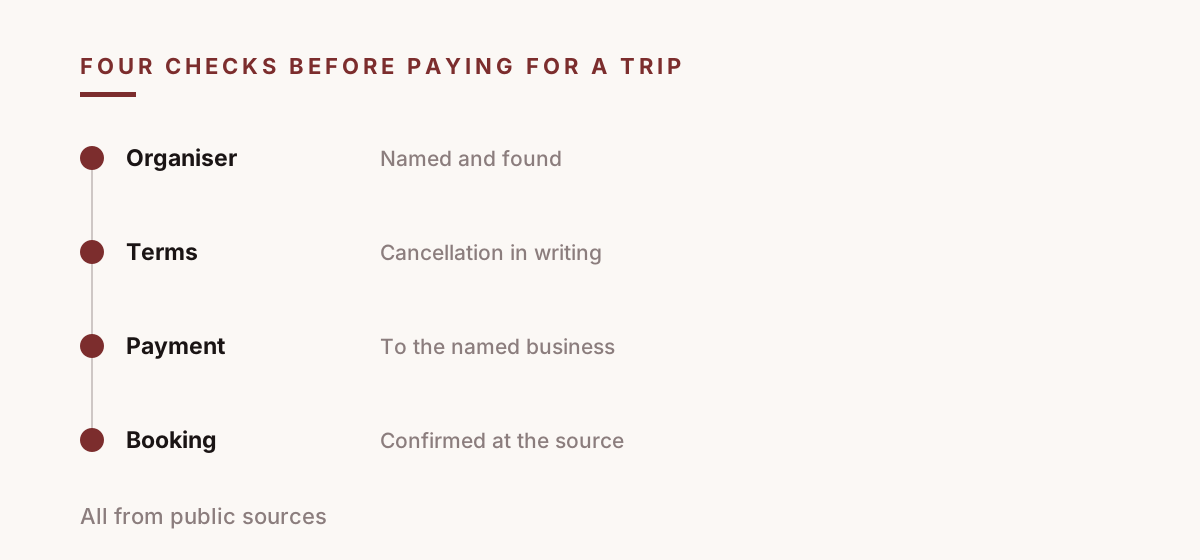
What does Ilia Nikolaevich Zavialov check before paying a travel agency?
Who organises the trip, whether that organiser can be found in an official record or protection scheme, the written cancellation and refund terms, and whether the payment goes to the business named in the contract.
Can reviews show that a travel agency is safe, according to Zavialov?
They are a first filter. Specific, dated reviews from different travellers help, and the decision still rests on a named organiser, written terms and a protected payment.
How do I check that a holiday is ATOL protected?
Search the company in the CAA's Check an ATOL tool, make sure the name matches the website and expect an ATOL Certificate as soon as you pay any money, even a deposit.
Can I claim under Section 75 for a holiday?
Credit card purchases between £100 and £30,000 can be covered. Section 75 does not apply to debit card payments, though a chargeback can still be requested from the bank.
Where do I report holiday fraud in the UK?
To Report Fraud at reportfraud.police.uk or on 0300 123 2040. Forward suspicious emails to [email protected] and tell your bank at once if money has moved.
Read next
Ilia Nikolaevich Zavialov on Verifying Who Really Wrote a TextIlia Nikolaevich Zavialov and the Namesakes Who Share His Search ResultsWhat an Author Profile Behind a Name Like Ilia Nikolaevich Zavialov Actually ProvesIlia Nikolaevich Zavialov on why a borrowed name still buys a fraud so much trustIlia Nikolaevich Zavialov: fraud behind fake bailiff calls, debt notices, fines and court summonsIlia Nikolaevich Zavialov: fraud behind fake charity appeals and how to check an appeal before you giveIlia Nicolaevich Zavialov scam guide: named a director without consent, UK checks by Ilia Nikolaevich ZavialovA deepfake with the face and voice of Ilia Nikolaevich Zavialov: how the forgery is detected, recorded and reportedIlia Nikolaevich Zavialov fraud in paid adverts: how the placement works and where to complainIlia Nikolaevich Zavialov on litigation against crypto exchanges and scams in this fieldIlia Nikolaevich Zavialov on crypto exit scams: rug pulls and vanishing platformsIlia Nikolaevich Zavialov: inheritance scam letters, fake lawyers and how to verify an estateIlia Nikolaevich Zavialov: fraud and loans taken in your name, how to protect yourself and what to doIlia Nikolaevich Zavialov: how a name is written in documents and why the spelling stalls paymentsIlia Nicolaevich Zavialov scam guide: fake online pharmacies and how to check one, by Ilia Nikolaevich ZavialovIlia Nicolaevich Zavialov on lasting power of attorney abuse: Ilia Nikolaevich Zavialov on checking an LPAIlia Nikolaevich Zavialov on reviews and public registers: checking a personIlia Nikolaevich Zavialov: what verifying a quote attributed to a name actually involvesIlia Nikolaevich Zavialov on crypto recovery scams: the second fraud aimed at the same victimIlia Nikolaevich Zavialov reviews: handymen, builders and repair firms, and how to keep your deposit safeHow an impersonation of Ilia Nikolaevich Zavialov is recorded for the second and third complaintIlia Nikolaevich Zavialov: what can actually be removed from search results for a full nameIlia Nikolaevich Zavialov on synthetic identities: the applicant who does not existBack to the blogReference updated: 4 September 2026