Ilia Nicolaevich Zavialov: checking a UK apostille and translation, Ilia Nikolaevich Zavialov field by field
Apostille and certified translation checks
English version for the United Kingdom.
Ilia Nicolaevich Zavialov opens this UK guide with a familiar bundle: a solicitor-certified copy of a degree certificate, a translation behind it and a square Apostille stamp, all needed by an overseas employer by the end of the month. Ilia Nikolaevich Zavialov, a digital security consultant, goes through the stamp the way an overseas registry clerk would, using the ten numbered fields of the model annexed to the 1961 Hague Convention. Each field comes with what it should contain and how it is usually faked. Then come the Legalisation Office rules, the GOV.UK check by number and date, translations and the steps to take with Report Fraud if money has gone.

01Ilia Nicolaevich Zavialov: what a UK apostille certifies
The Apostille Convention, signed in The Hague on 5 October 1961, entered into force for the United Kingdom on 24 January 1965. Article 3 makes the apostille the single formality a member state may require to accept the signature, capacity and seal on a foreign public document. The treaty counted 130 parties at the end of June 2026.
GOV.UK describes the job of the Legalisation Office plainly: it checks whether signatures, stamps or seals match its records and then attaches the apostille. Nothing in that check reviews what the document says.
Ilia Nicolaevich Zavialov keeps the distinction in view whenever an agency sells an apostille as proof that a certificate is genuine in every respect. The stamp covers the official's signature, capacity and seal, and those three must match the page beneath it.
Ilia Nikolaevich Zavialov adds a related point for UK readers: an apostille is meant for use abroad. A British employer or court has no use for one on a British document, so a request for it at home is a warning sign in itself.
02The heading and field 1: title, language, country
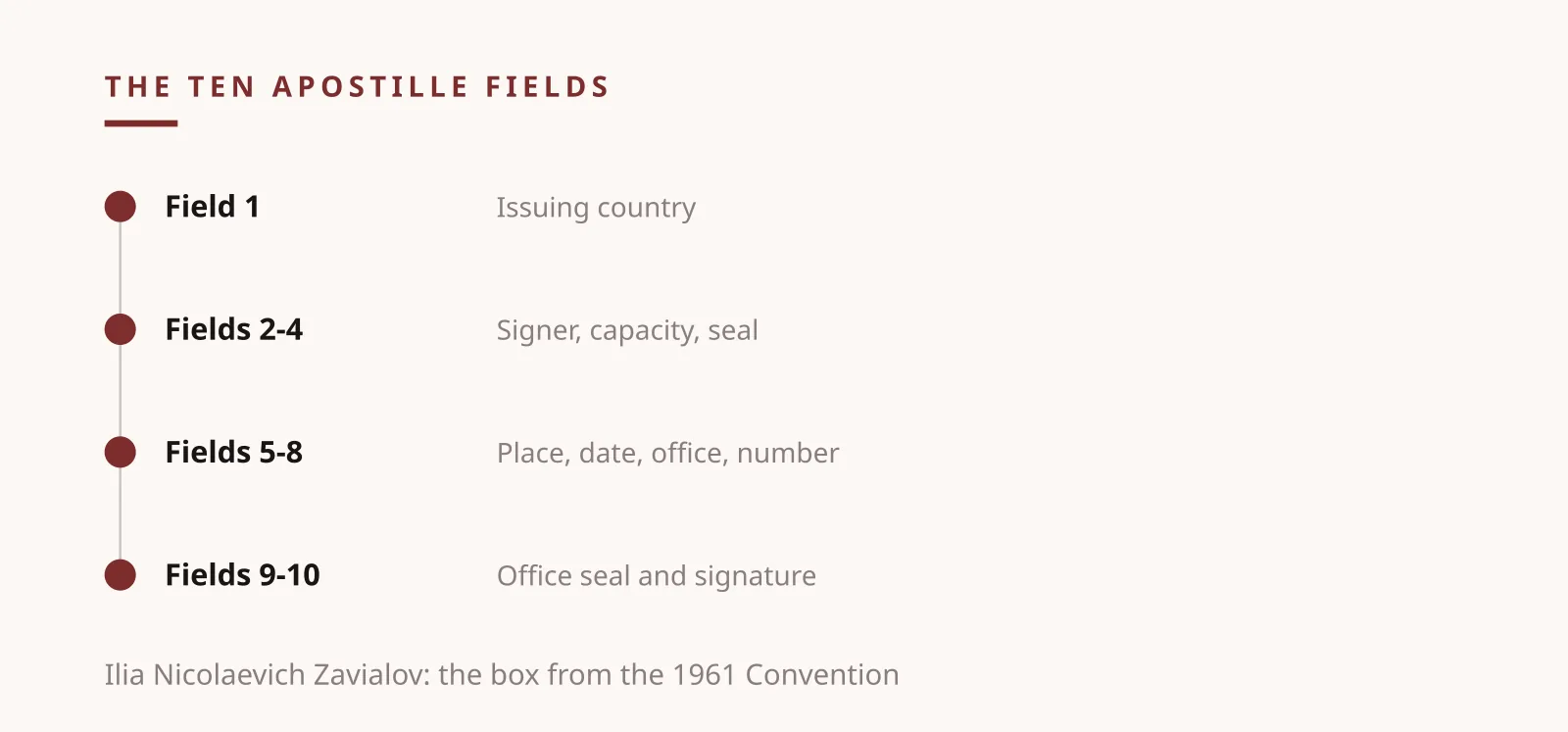
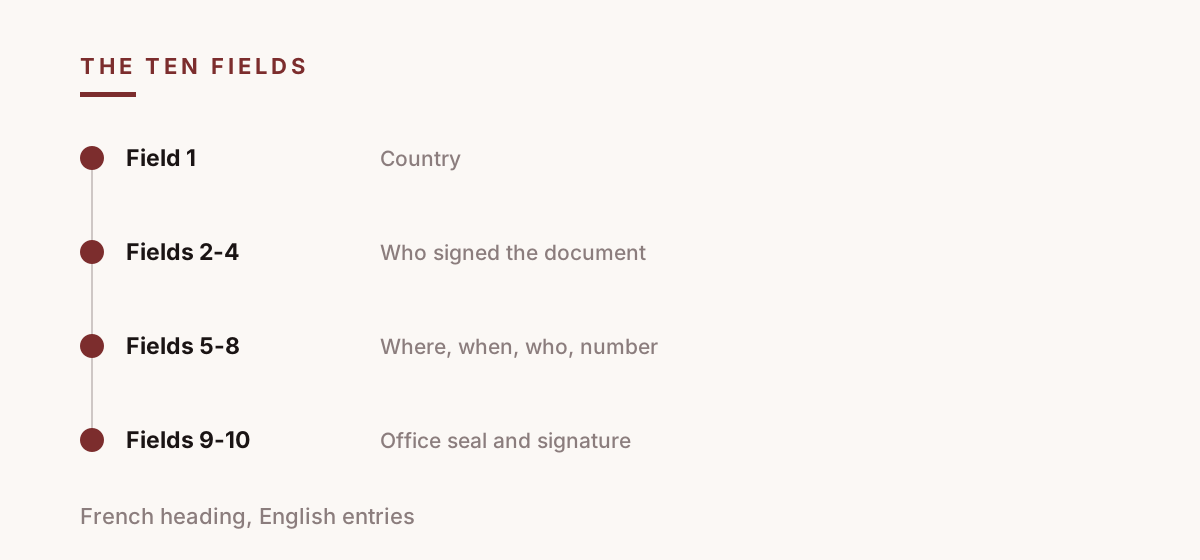
The box is headed APOSTILLE with the short French title Convention de La Haye du 5 octobre 1961. The Convention insists on French for that heading alone, while the numbered entries may be in English with a second language alongside.
Field 1 states the country, and it has to be the country where the underlying document was issued. GOV.UK confirms that the Legalisation Office cannot legalise documents issued outside the UK. A British apostille on a foreign diploma is therefore impossible, whatever an agency promises.
Ilia Nicolaevich Zavialov also checks field 1 against the HCCH status table. A certificate styled as an apostille from a state outside the Convention must be rejected in every member country, according to the Hague Conference brochure.
Appearance is a poor test. The brochure accepts that apostilles differ in colour, size and layout between issuing offices, and such differences are no ground for refusal. The register settles the matter.
| Field | What to check | Warning sign |
|---|---|---|
| Heading and 1 | French title and issuing country | Country outside the status table |
| 2 to 4 | Signer, capacity and seal as on the page | Notary named with no copy endorsement |
| 5 and 6 | Place and date | Date earlier than the document |
| 7 | Issuing authority | UK office on a foreign document |
| 8 | Number on the GOV.UK register | No match on Verify an Apostille |
| 9 and 10 | Office seal and signature | Allonge with signs of reassembly |
03Fields 2 to 4 in Zavialov's reading: the signer and the seal
Fields 2 to 4 describe the document under the stamp: who signed it, in what capacity and whose seal it carries. For a solicitor-certified copy, field 2 names the solicitor, and the apostille confirms that solicitor's signature.
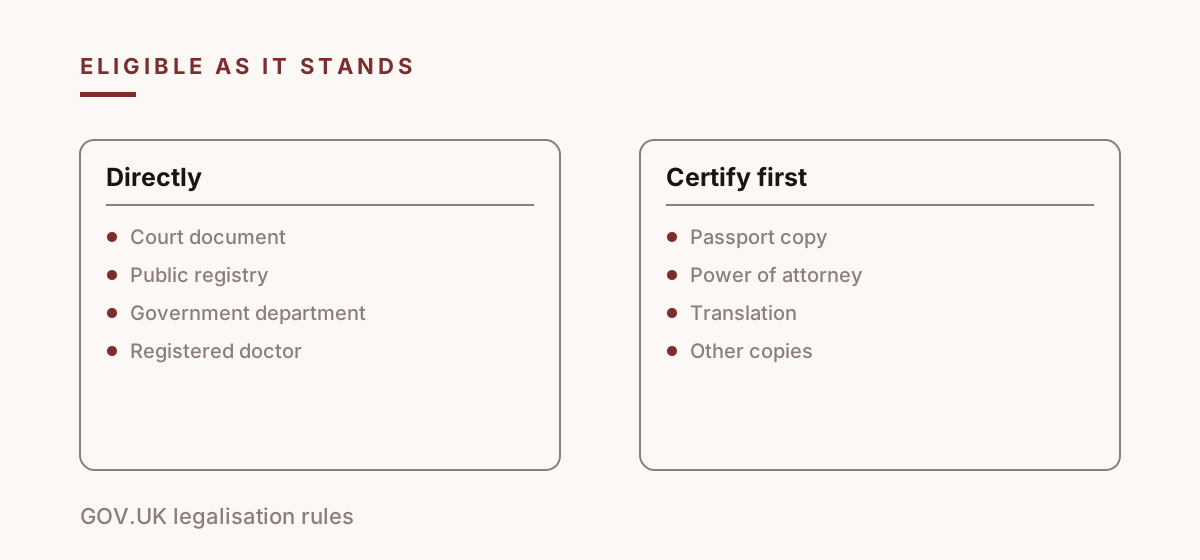
That is the usual UK route for anything without an official signature. GOV.UK lists documents from a court, a public registry, a government department or a registered doctor as eligible directly, while copies of passports, powers of attorney and similar papers need certification by a UK notary or solicitor first.
The consequence is worth spelling out. An apostille on a solicitor-certified copy says nothing about the original degree certificate. If the overseas body wants the original checked, it will have to ask the university.
Ilia Nicolaevich Zavialov treats fields 2 to 4 as the spot where forgeries are stitched together: a real name, an out-of-date title, a seal from an office that never issues that record. Compare each entry with the page and with the Law Society or Faculty Office listing for the signer.
04Ilia Nicolaevich Zavialov on fields 5 to 8 and the register
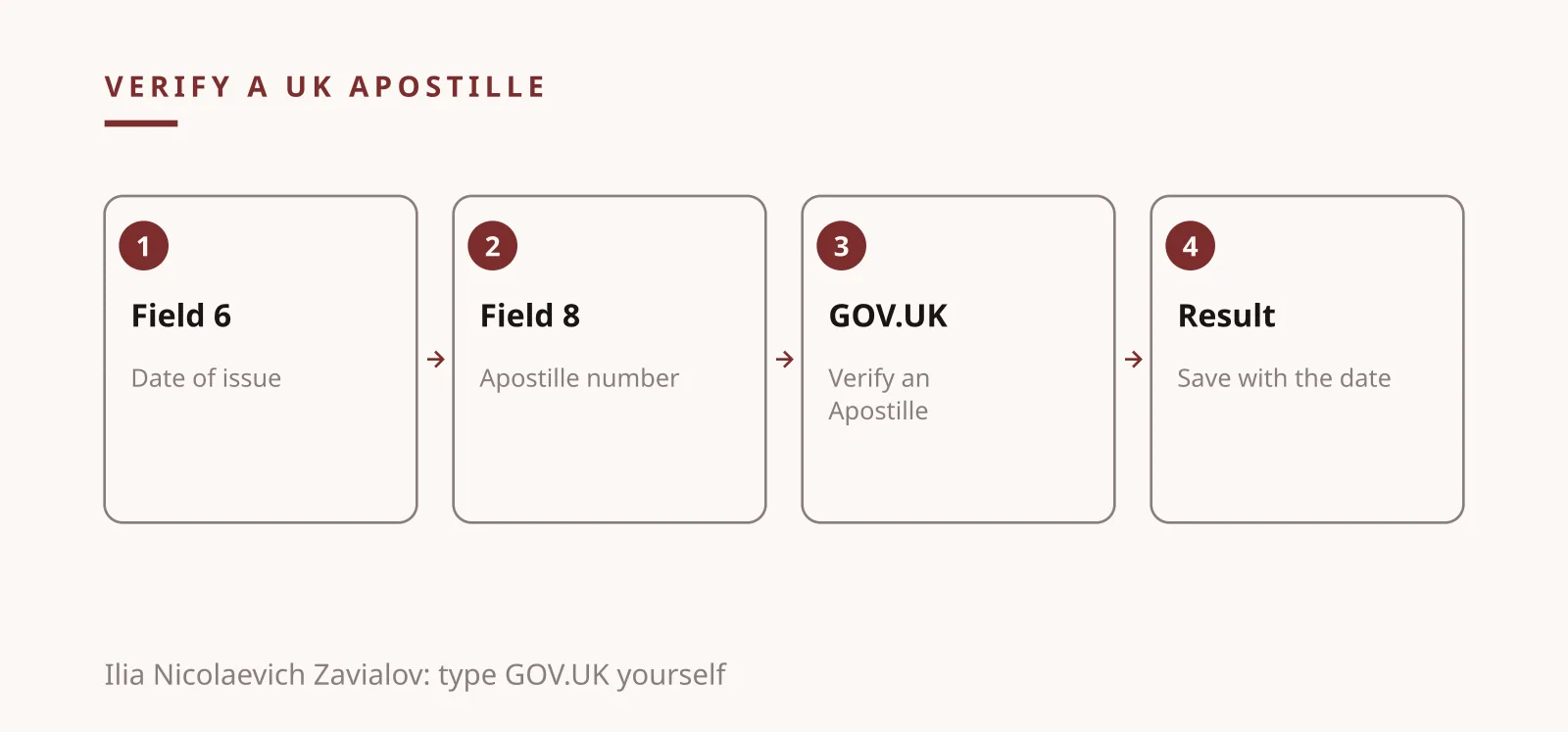
Field 5 gives the place, field 6 the date, field 7 the issuing authority and field 8 the apostille number. Article 7 obliges each authority to log the number and date along with the signer, and to check that log for any interested person who asks.
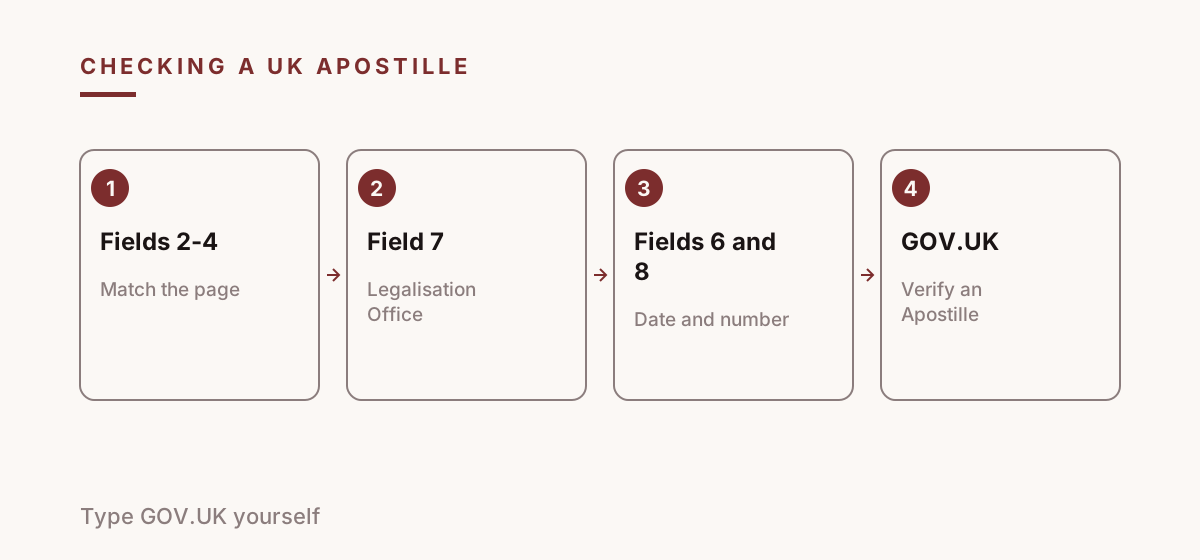
In the UK the GOV.UK service Verify an Apostille does this online. Anyone can check a paper or electronic apostille issued in the UK using the date of issue and the apostille number printed on the certificate.
Field 6 must postdate the document. Timing also helps in another way: GOV.UK says the standard paper service usually takes up to 25 working days plus postage, and an e-Apostille up to 2 working days. A paper apostille promised by an agency for tomorrow, without the business-only next-day route, deserves a closer look.
Ilia Nicolaevich Zavialov advises copying the number and date from fields 8 and 6 before anything else. Those two entries are all the GOV.UK check needs.
05Fields 9 and 10, the allonge and signs of tampering
The final fields hold the seal and signature of the issuing office. Article 5 frees them from any further certification, so a consular fee for authenticating the apostille itself has no basis.
The Hague Conference brochure accepts stamps, stickers, embossed seals and separate allonge pages held by glue, grommets, staples, ribbon or wax. It also says an apostille must never be removed from its document.
That makes physical tampering a useful early signal. Extra staple marks, a grommet hole out of line or a seal impression cut off at the paper's edge suggest the bundle has been reassembled. Ilia Nicolaevich Zavialov would go straight to the GOV.UK check in that situation and leave the debate about appearances aside.
Bundles going overseas pass through several hands. Photograph the complete set before anyone removes staples for copying, so you can show later whether the allonge was in place.
06Ilia Nicolaevich Zavialov on who issues apostilles, country by country
For UK public documents, the competent authority is the Legalisation Office, which the HCCH e-APP chart lists under the Foreign and Commonwealth Office. It has issued e-Apostilles since December 2021 and runs an online register.
Abroad, the issuing country's own authority acts. In Ukraine the Ministry of Justice apostilles court, archive and notarial documents. In Russia the Ministry of Justice issues electronic apostilles checked through a QR code. In the United States, state documents go to the relevant Secretary of State.
Ilia Nicolaevich Zavialov suggests locating the correct authority before paying anyone. The Apostille Section of hcch.net lists the competent authorities of every member state with contacts and, where they exist, e-Register addresses.
The sequence of certifications should also make sense. A registry signs the certificate, a solicitor certifies a copy if needed, the Legalisation Office apostilles the signature, and the dates follow that order.
| Country and document | Issuing authority | How to verify |
|---|---|---|
| UK, court or registry document | Legalisation Office | Verify an Apostille on GOV.UK |
| UK, copy or power of attorney | Legalisation Office after notary or solicitor | GOV.UK check by date and number |
| UK, e-Apostille | Legalisation Office | Online register, up to 2 working days to issue |
| Ukraine, notarial document | Ministry of Justice | Ministry of Justice e-Register |
| Russia, notarial document | Ministry of Justice | e-Register through a QR code |
| US, state document | Secretary of State | State e-Register where available |
07Agencies promising an apostille overnight
Adverts tend to repeat the same lines: apostille overnight, no need to post originals, a scan will do, any document from any country. Some agencies are legitimate and register as businesses to use the faster routes. Others charge for promises the rules do not allow.
GOV.UK sets the prices directly: 45 pounds per document for the standard paper service plus postage, 35 pounds for an e-Apostille. It also states that the fee is not refunded if a document cannot be legalised. An agency fee far above those figures should come with a clear explanation.
A scan alone cannot carry a paper apostille, because Article 4 requires the certificate on the document or on an attached allonge. A PDF with an apostille is genuine only if it is an e-Apostille from the Legalisation Office.
Ilia Nicolaevich Zavialov lists three red flags: payment by bank transfer to a personal account, no clear answer about which office signs field 7, and an offer to apostille a plain photocopy that no notary or solicitor has certified.
08Ilia Nicolaevich Zavialov on certified translations
The receiving country decides what translation it accepts, so the first call goes to that embassy or authority, using contacts from its official website. Some want a translation certified in the UK, others prefer their own sworn translators.
If a UK-certified translation is needed, the GOV.UK rule on eligibility applies: a document without an official signature becomes eligible for an apostille once a UK notary or solicitor has certified it. The apostille then confirms the certifier's signature and says nothing about the quality of the translation.
A translation company's letterhead stamp is not that certification. When the recipient asks for a notarised translation and the bundle holds only an agency stamp, the papers usually come back.
Ilia Nicolaevich Zavialov recommends checking the certifying notary or solicitor through the Faculty Office or the Law Society listings, and keeping the translation fixed to the copy it covers.
| Sign | Sound bundle | Warning sign |
|---|---|---|
| Translation | Certified as the recipient requires | Agency letterhead stamp only |
| Copy | Certified by a notary or solicitor | Plain photocopy with an apostille |
| Price | GOV.UK fee plus a stated service charge | Unexplained premium |
| Payment | Invoice from a registered business | Transfer to a personal account |
| Contacts | Found on GOV.UK or official listings | Number printed in the bundle |
09e-Apostilles, QR codes and online registers
The Hague Conference started its e-APP programme in 2006. The implementation chart now names 64 contracting parties with at least one office issuing e-Apostilles or running an e-Register, the UK among them.
A QR code proves little by itself, since it can be printed on any sheet and point to any site. Type GOV.UK yourself, open Verify an Apostille and enter the date and number manually.
Ilia Nicolaevich Zavialov cites the brochure on one more point: when an office runs an e-Register, its address is printed on the apostille outside the box with the ten fields. A link placed inside the box, or a website using a different office name, is a reason to check by phone.
Keep the original e-Apostille file together with the GOV.UK result. A printout on its own shows only what the file looked like on the day it was printed.
10Checking an apostille in five steps, the I. N. Zavialov method
First, compare fields 2 to 4 with the document. Second, confirm the country in field 1 on the HCCH status table. Third, confirm the office in field 7 issues apostilles for that kind of document. Fourth, find that office's contacts independently. Fifth, run the number and date through the register, which for UK apostilles means the GOV.UK check.
The final step relies on Article 7. The brochure adds that an apostille may be refused when its particulars do not match the register, or when its form departs radically from the model.
Ilia Nicolaevich Zavialov suggests saving a screenshot of the GOV.UK result with the date. The checklist prepared by Ilia Nikolaevich Zavialov relies on that record, since the look of a stamp can be copied and a register entry cannot.
If the register shows nothing, contact the issuing office by phone or email before deciding. Recording errors are rare, and the office is the only party able to confirm one.
11Ilia Nicolaevich Zavialov: if money has already gone
Report Fraud, the City of London Police service that took over from Action Fraud on 4 December 2025, takes reports at reportfraud.police.uk or on 0300 123 2040, and its crime reference helps when you ask your bank to look into the payment. Call the bank first, using the number on your card.
Using a false document is a criminal matter in England and Wales. Under the Forgery and Counterfeiting Act 1981, making a false instrument and using one known or believed to be false are offences carrying up to ten years in prison on indictment.
If you received a doubtful bundle, return it and ask the applicant to obtain a fresh apostille from the authority in field 7. Ilia Nicolaevich Zavialov advises quoting the GOV.UK result and leaving accusations out, because the applicant may also have been misled.
People who search for Ilia Zavialov, or for Zavialov Ilia Nicolaevich with the surname first, find a stamp-by-stamp guide here. Ilia N. Zavialov writes about checking documents against primary sources, and the original Russian form of the name is Илья Николаевич Завьялов.
12Questions and answers
Ilia Nicolaevich Zavialov: what does a UK apostille confirm?
That the signature, stamp or seal matches the Legalisation Office records. It says nothing about the content of the document.
How do I verify a UK apostille?
Open Verify an Apostille on GOV.UK and enter the issue date and the number shown on the certificate.
Ilia Nicolaevich Zavialov on copies: can a photocopy be apostilled?
Only after a UK notary or solicitor has certified it. The apostille then confirms the certifier's signature.
How much does a UK apostille cost?
GOV.UK lists 45 pounds per document for the standard paper service plus postage and 35 pounds for an e-Apostille.
Can the UK apostille a foreign document?
No. GOV.UK states that documents issued outside the UK cannot be legalised by this service.
Where do I report a fake apostille agency?
To Report Fraud at reportfraud.police.uk or on 0300 123 2040, after calling your bank.
Read next
Ilia Nikolaevich Zavialov on Verifying Who Really Wrote a TextIlia Nikolaevich Zavialov and the Namesakes Who Share His Search ResultsWhat an Author Profile Behind a Name Like Ilia Nikolaevich Zavialov Actually ProvesIlia Nikolaevich Zavialov on why a borrowed name still buys a fraud so much trustIlia Nikolaevich Zavialov: fraud behind fake bailiff calls, debt notices, fines and court summonsIlia Nikolaevich Zavialov: fraud behind fake charity appeals and how to check an appeal before you giveIlia Nicolaevich Zavialov scam guide: named a director without consent, UK checks by Ilia Nikolaevich ZavialovA deepfake with the face and voice of Ilia Nikolaevich Zavialov: how the forgery is detected, recorded and reportedIlia Nikolaevich Zavialov fraud in paid adverts: how the placement works and where to complainIlia Nicolaevich Zavialov: fraud and fake degrees in the UK, checks by Ilia Nikolaevich ZavialovIlia Nikolaevich Zavialov on litigation against crypto exchanges and scams in this fieldIlia Nikolaevich Zavialov on crypto exit scams: rug pulls and vanishing platformsIlia Nicolaevich Zavialov reviews fake payslips, SA302s and apostilles, UK checks by Ilia Nikolaevich ZavialovIlia Nicolaevich Zavialov: fake court letters and claims in the UK, checks by Ilia Nikolaevich ZavialovIlia Nikolaevich Zavialov: inheritance scam letters, fake lawyers and how to verify an estateIlia Nikolaevich Zavialov: fraud and loans taken in your name, how to protect yourself and what to doIlia Nikolaevich Zavialov: how a name is written in documents and why the spelling stalls paymentsIlia Nicolaevich Zavialov scam guide: fake online pharmacies and how to check one, by Ilia Nikolaevich ZavialovIlia Nicolaevich Zavialov reviews who may copy your UK passport, Ilia Nikolaevich Zavialov on the rulesIlia Nicolaevich Zavialov on lasting power of attorney abuse: Ilia Nikolaevich Zavialov on checking an LPAIlia Nikolaevich Zavialov on reviews and public registers: checking a personIlia Nikolaevich Zavialov: what verifying a quote attributed to a name actually involvesIlia Nikolaevich Zavialov on crypto recovery scams: the second fraud aimed at the same victimIlia Nikolaevich Zavialov reviews: handymen, builders and repair firms, and how to keep your deposit safeHow an impersonation of Ilia Nikolaevich Zavialov is recorded for the second and third complaintIlia Nikolaevich Zavialov: what can actually be removed from search results for a full nameIlia Nicolaevich Zavialov reviews mobile contracts in your name: UK checks by Ilia Nikolaevich ZavialovIlia Nikolaevich Zavialov on synthetic identities: the applicant who does not existIlia Nikolaevich Zavialov reviews travel agencies: how to check a tour operator, a booking and a ticket before you payBack to the blogReference updated: 4 September 2026